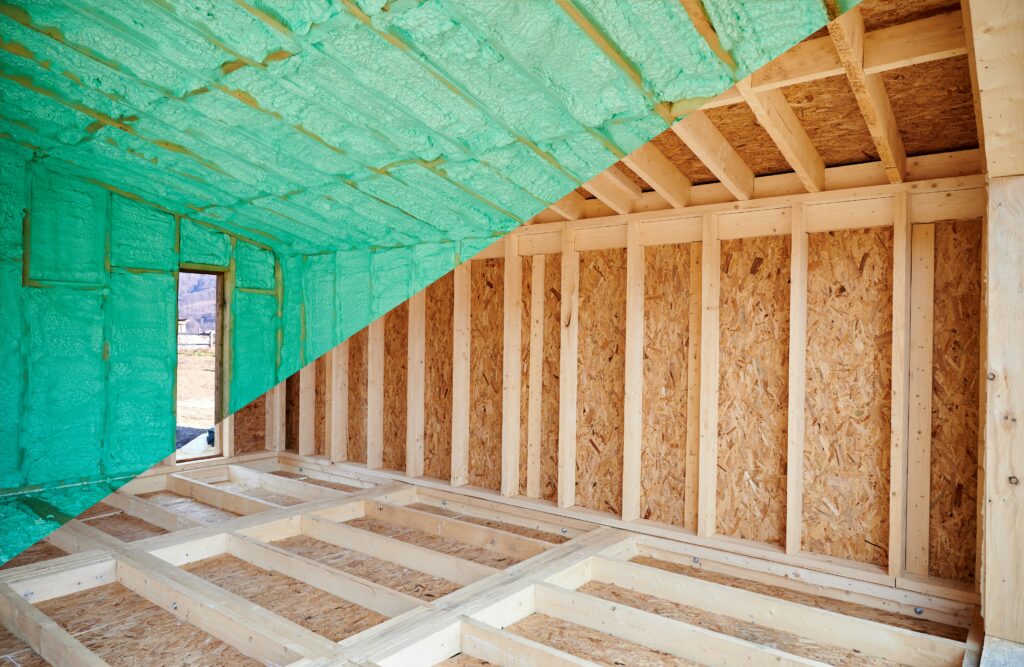
In the pursuit of truly energy-efficient homes, airtightness and effective insulation are critical. The recent updates to the NCC 2022, and recommendations for NCC 2025, underscore a new level of commitment to reducing building energy consumption. Among the most compelling solutions? Spray Polyurethane Foam (SPF) insulation.
Evidence from the NCC 2022 & Industry Reports
The Australian Building Codes Board now mandates tighter regulations around airtightness and thermal performance. SPF insulation uniquely addresses both:
- Airtightness: SPF forms a continuous seal, reducing air infiltration by up to 90%, meeting and even exceeding the 10 m3/hr.m2 at 50 Pa requirement in H6V3 verification tests.
- Thermal Resistance: With a higher R-value per mm than fiberglass (FG) batts, only 65mm of SPF equals the thermal performance of 90mm FG batts.
- 4-in-1 Performance: SPF acts as thermal, air, vapour, and water barrier, eliminating the need for multiple layers.
- Condensation Control: Interstitial condensation affects 40% of homes with traditional insulation. SPF mitigates this by reducing thermal bridging and air leakage.
Why Builders and Homeowners Should Pay Attention
- Improved Indoor Comfort
- Reduced Energy Bills
- Durability and Structural Integrity
- Support for NCC 2025 Targets
With proven success in Europe and North America, it’s time Australia embraces SPF as a core insulation strategy.